The Politics of Non Cooperation
- Kishor Arjun
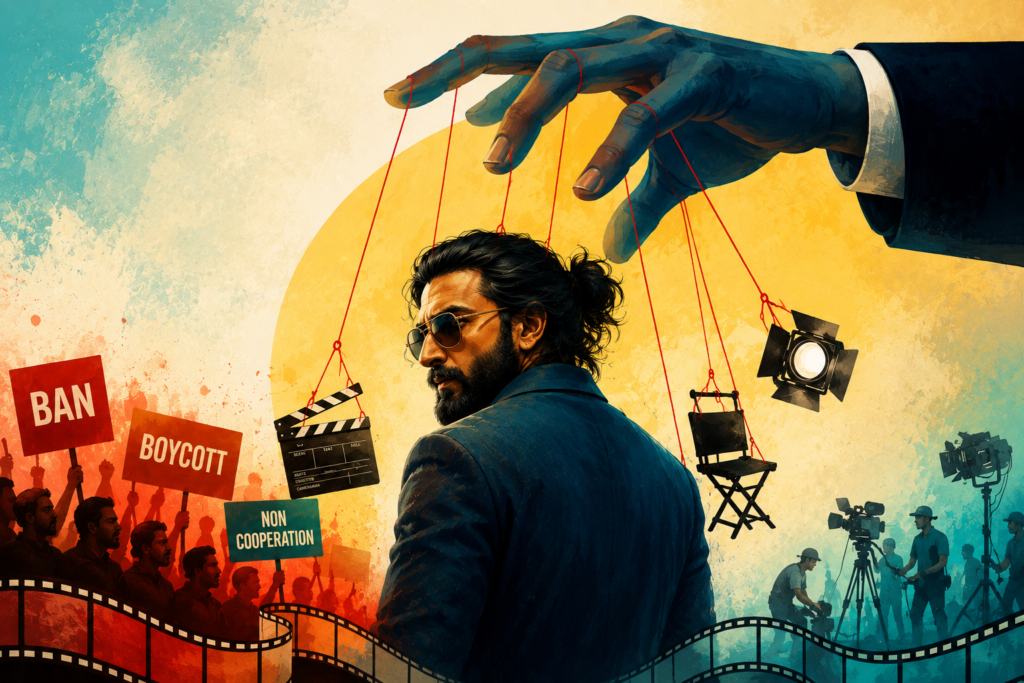
Days after actor Ranveer Singh visited the Chamundeshwari Temple in Mysore seeking forgiveness for his controversial remarks on Kantara, another controversy landed at his doorstep. The Federation of Western India Cine Employees (FWICE) announced a non-cooperation directive against him following allegations that he abruptly exited Don 3, causing financial losses to the producers. While the Federation clarified that the move was not a formal ban, the episode has revived an old debate within the film industry: how much power should industry bodies have over artists?
The question extends far beyond Ranveer Singh. For decades, film associations and trade unions across India have imposed bans, boycotts and non-cooperation directives against actors, singers and technicians over issues ranging from contractual disputes and professional misconduct to political controversies and personal conduct. While these organisations argue that such measures are necessary to protect workers and maintain professional discipline, critics often see them as exercises in institutional overreach. The latest controversy has once again brought into focus the uneasy balance between labour rights, artistic freedom and the power structures that govern India’s film industry.
The Role of FWICE
The Federation of Western India Cine Employees is among the most influential trade bodies in India’s entertainment industry. Serving as an umbrella organisation for more than thirty unions, it represents thousands of workers, including technicians, junior artists, makeup artists, editors, spot boys and lightmen.
Established in 1958, the organisation was created to safeguard workers’ rights, wages and working conditions. Over the years, however, its role has expanded beyond labour issues. Today, it frequently intervenes in disputes involving artists, producers and production houses.
The dispute involving Ranveer Singh and Don 3 is one such example. Following a complaint from director Farhan Akhtar and the film’s producers, FWICE directed its affiliated unions not to cooperate with projects involving the actor. The organisation clarified that the move was not a formal ban but a non-cooperation directive.
Legally, such directives carry little authority. Courts have repeatedly held that no individual can be prevented from pursuing a lawful profession. While hearing petitions related to restrictions on Pakistani artists in 2017, the Bombay High Court observed that no citizen could be denied the right to work merely because of public sentiment or political pressure.
Yet the practical reality is different. Cinema is a collaborative industry involving hundreds of workers. If technicians, workers or affiliated unions refuse to cooperate, production schedules can be disrupted, costs can rise, and projects can suffer significant delays. For this reason, even informal directives can carry substantial influence.
Bans, Boycotts and Non-Cooperation in Bollywood
The roots of such actions can be traced back to the studio era of the 1940s and 1950s, when artists worked under exclusive contracts with production houses. Violations of contractual obligations often resulted in suspension or termination. As the star system emerged and actors began working independently, industry associations gained greater influence in regulating professional conduct.
One of the most prominent examples came in 2016 after the Uri terrorist attack. Amid growing political pressure, the Indian Motion Picture Producers Association announced a ban on Pakistani artists and technicians working in India. Popular performers such as Rahat Fateh Ali Khan, Fawad Khan and Mahira Khan suddenly found themselves shut out of the industry.
A similar situation unfolded in 2019 when FWICE issued a non-cooperation directive against singer Mika Singh after he performed at a private event in Karachi during a period of heightened tensions between India and Pakistan. The directive was later withdrawn after the singer apologised and paid a fine.
Kangana Ranaut’s experience reflects a different form of industry isolation. Although no organisation formally announced a ban against her, her outspoken views on nepotism, her political positions and her public disputes with fellow actors reportedly made many producers and studios hesitant to collaborate with her.
Lessons from the South
The South Indian film industry has witnessed similar episodes.
Actor Nayanthara faced tensions with producers and industry bodies during a period marked by scheduling and financial disputes. While no formal ban was imposed, the episode highlighted the pressure that industry organisations can exert on even the biggest stars.
Veteran Tamil actor Vadivelu also experienced professional isolation following disputes with producers and his involvement in political campaigning during the 2011 Tamil Nadu Assembly elections. For several years, his presence in mainstream cinema remained limited.
In Kerala, actor Shane Nigam faced a temporary ban in 2019 after producers accused him of failing to adhere to shooting schedules and engaging in unprofessional conduct. Similarly, actor Sreenath Bhasi faced restrictions from producers’ associations in 2022 following allegations of misconduct towards a journalist. Both cases were eventually resolved through dialogue and reconciliation.
The controversy surrounding actor and producer Dileep generated even wider debate. Following criminal allegations involving the assault of a fellow actor, he faced varying levels of institutional distancing within the Malayalam film industry. Veteran actor Thilakan had earlier experienced a prolonged conflict with industry organisations, leading to what many regarded as an informal boycott.
Why Do Such Actions Exist?
Cinema may be an art form, but it is also a business that depends on significant financial investment. A commercial film often employs hundreds of workers across multiple departments. When a major actor abandons a project or causes serious disruptions, the financial consequences can be enormous.
Such setbacks affect not only producers but also technicians, daily wage workers and others whose livelihoods depend on a project’s completion. From this perspective, industry bodies argue that disciplinary measures are necessary to protect workers and maintain professional standards.
For unions and associations, non-cooperation directives are often seen as tools of accountability. They are intended to discourage irresponsible behaviour and minimise financial risks to the industry.
Are They Still Effective?
The effectiveness of such measures has changed considerably over time.
In the past, when the industry was controlled by a relatively small network of producers, distributors and cinema halls, bans and boycotts could seriously damage an artist’s career. Today, the landscape is far more fragmented.
The growth of OTT platforms, independent production houses and digital media has created alternative avenues for artists. Many actors continue to enjoy audience support despite controversies, boycotts or temporary restrictions. In some cases, such actions even generate public sympathy.
As a result, non-cooperation directives remain influential but are no longer as decisive as they once were.
The Limits of Institutional Power
No industry body can permanently prevent a major star from working. Investors continue to back commercially viable actors, and market forces ultimately shape career trajectories more than institutional pressure.
Yet organisations such as FWICE continue to serve an important purpose. They protect workers, defend labour rights and help maintain professional discipline within an industry where the actions of a single individual can affect hundreds of livelihoods.
The more difficult question arises when such organisations move beyond labour welfare and begin policing social conduct, political views or public controversies. The line between protecting workers’ interests and exercising moral authority can easily become blurred.
That is where the real debate lies. The issue is not whether film industry bodies should exist or whether they should protect workers. The issue is how far their authority should extend. As controversies such as the one involving Ranveer Singh continue to emerge, the answer to that question will increasingly define the balance of power between stars, producers and the institutions that govern India’s film industry.