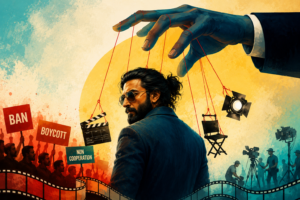
Who Is Shaping Our Taste in the Digital Age?
– Kishor Arjun
Every new medium in the history of entertainment has altered the way we live. Radio brought the spoken word into our homes; television brought images into our living rooms; and the Internet put the entire world in our pockets. But the transformation taking place today is different. For we are not merely changing what we watch and listen to; we are also, often without realizing it, changing the very way we see, hear and think.
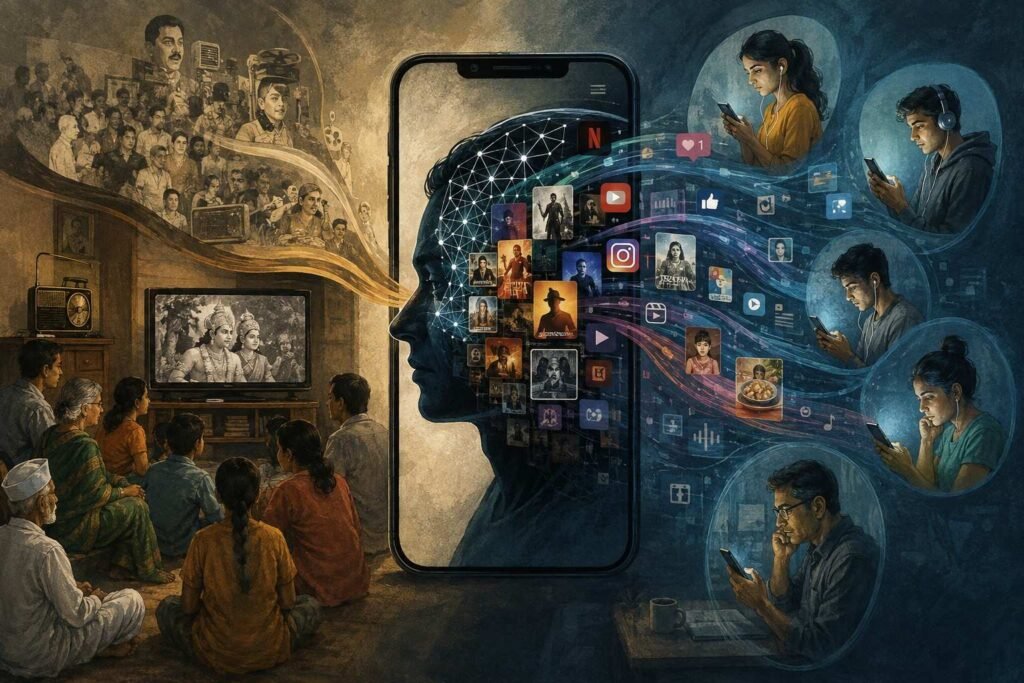
There was a time when entertainment was a collective experience. Radio plays, television programms such as Chitrahaar, Ramayan and Mahabharat, the Sunday movie, or televised performances of Marathi theatre did more than entertain an audience. They created and shaped the cultural memories of an entire generation. The next day, people would discuss these programms at school, at the workplace or on the street corner. Millions experiencing the same story at roughly the same time created a shared emotional and cultural universe.
Entertainment was certainly a commercial enterprise even then. But it was also an integral part of the larger cultural conversation of society.
That picture has changed dramatically.
Entertainment is no longer bound by time, place or broadcast schedules. The smartphone has placed an individual screen in every hand. On a train journey, on a college campus, at the office, over dinner or just before going to sleep, we are watching reels, web series, podcasts and films. The screen has become smaller; the world on it has become limitless.
And something fundamental has happened as a result.
Earlier, a common story could connect an entire society through entertainment. Today, every individual increasingly inhabits a different digital universe. Four people living in the same house may watch four different things, experience four different narratives and, at times, inhabit four different versions of reality.
Entertainment is no longer merely a collective experience. It has become personal, fragmented and constantly shifting.
And behind this transformation are not merely faster Internet connections, cheaper smartphones or streaming platforms. There is also the largely invisible power of the algorithm.
What appears at the top of our Netflix screen, which video YouTube recommends next, which reel appears on Instagram or which song Spotify suggests is no longer determined entirely by us. Every click, every preference and every pause is recorded by computational systems that construct a digital portrait of our behavior and use it to decide what should be shown to us.
Everyone’s screen now presents a slightly different world.
And this has consequences for our shared cultural experience.
A new cultural reality is emerging in which the viewer does not always choose the film or the series. Increasingly, the algorithm helps shape the viewer’s taste.
The Viewer Becomes the Raw Material
The revolution brought about by inexpensive mobile data, the era of the ubiquitous daily data pack, took digital media within a few years from metropolitan centers to villages and small towns.
Today, a young person in a small town in Maharashtra can publish a work on YouTube with the same ease with which it can potentially reach an audience in New York or Tokyo. This is one of the great democratizing possibilities of the digital age.
Regional languages, folk arts, music, short films, podcasts and a new generation of artists have found unprecedented platforms through digital media. Marathi cinema is no exception. Films that once struggled to reach audiences because of limited theatrical distribution can now be watched across India and abroad through streaming platforms. Social media has given several folk artists and performers from rural areas their first national audience.
The doors of creation have certainly opened wider.
But there is a paradox.
Creation has been democratized, but distribution has become centralized.
In other words, opportunities have increased, but access to those opportunities is not equally distributed.
Just as coal and steel became the foundations of production during the Industrial Revolution, data became the new wealth of the Information Age. But in today’s digital economy, something even more valuable is at stake: human attention.
How long we stay on a screen, where our thumb pauses, which post we share, which advertisement we click on, or after how many seconds we abandon a video, every such action generates information on which a multibillion-dollar digital economy is built.
The viewer, therefore, is no longer merely a consumer. In a sense, the viewer himself has become raw material for the digital economy.
Once, we bought a ticket to watch a film. Today, many digital services create the impression that they are free. But the price is often paid in our attention and personal data, without our fully recognizing the transaction.
This has fundamentally altered the economics of entertainment.
Once, box-office collections, television ratings or newspaper circulation were among the principal measures of success. Today, metrics such as watch time, engagement, retention, scrolling behavior and click-through rates increasingly determine the fate of a piece of content.
The value of a work is beginning to depend less on what it says and more on how long it can hold the viewer’s attention.
This is not merely a commercial transformation. It marks a change in our cultural value system.
Once, in a bookshop or library, we might have picked up a book by an unfamiliar writer simply because it happened to catch our eye. While changing television channels, we might have stumbled upon an excellent documentary, play or film by accident.
Such accidents often expanded our taste.
The algorithm, however, has little faith in such accidents.
It repeatedly takes us back into the same circle of preferences. We stop discovering unfamiliar worlds and instead find ourselves, as if in a hall of mirrors, surrounded by reflections of our own tastes.
The Human Being Beyond the Algorithm
Today, whether a viewer stays beyond the first 30 seconds of a trailer, whether a thumbnail is sufficiently attractive, or whether a title generates enough clicks can matter almost as much as the story itself.
In the race to capture attention within a few seconds, patience, artistic restraint and slower forms of storytelling are increasingly pushed to the margins.
Going viral and being valuable are two different things. Yet in the digital age, they are often measured on the same scale.
In recent years, artificial intelligence has accelerated this transformation even further.
AI is already reshaping translation, dubbing, editing, screenwriting, music generation and post-production. For regional Indian cinemas, including Marathi cinema, this could be a major opportunity. A Marathi film, for instance, could potentially reach audiences in several languages at a fraction of the earlier cost.
The technology could also play an important role in preserving folk traditions, rare recordings, old films and other forms of cultural heritage.
But, like every technological revolution, this one raises difficult questions.
If AI writes a story in the style of a particular writer, who is its author?
If the voice of a deceased singer is recreated artificially, who owns the ethical and legal rights to that voice?
If an actor’s face and voice can be digitally recreated, what exactly should the legal and moral limits be?
These are not merely questions of law. They concern artistic freedom and the very meaning of creativity.
Every new medium has historically generated fears about the death of the old. Photography did not kill painting. Television did not destroy theatre. The Internet did not make books irrelevant. Each medium eventually found its own place and developed its own language.
It would therefore be premature to conclude that AI will make artists obsolete.
But there is a fundamental difference this time.
Until now, technology was primarily a tool for creating works of art. Today, technology is beginning to influence not only what is created, but also what should be created, who should see it, and what should become popular.
And that is perhaps the most important dimension of the transformation taking place around us.
The algorithm does not merely influence the audience. It can also influence the artist.
When creators begin asking what will generate clicks, what will perform better, how quickly a story must reveal its hook, what kind of thumbnail will attract attention, or what subject is likely to go viral, the logic of the algorithm begins to enter the creative process itself.
The question, then, is no longer simply whether technology is changing our taste.
It is whether our desire to please the algorithm is beginning to change the way culture is produced.
This does not mean that we should view technology with suspicion.
The question is not whether technology is good or bad. The real question is: who controls it, and for what purpose?
If the primary objective of an algorithm is simply to keep users on a screen for as long as possible, it can narrow the cultural imagination of society.
But if the same technology is used to introduce audiences to different languages, folk traditions, emerging artists and alternative cultural expressions, it can also strengthen cultural democracy.
Entertainment, therefore, is no longer merely a matter of leisure. It has become a question of culture, economics and even democracy.
Which brings us to the fundamental question.
The real issue is not OTT platforms, artificial intelligence or social media by themselves. It is cultural autonomy.
Can we build a system in which diversity matters as much as or more than, popularity?
Can artists retain the freedom to create honestly, not merely to satisfy an algorithm but to remain faithful to their own creative instincts?
And can viewers retain the curiosity to step outside the boundaries of what they already like and encounter unfamiliar experiences?
Because culture is not born from an algorithm. It is born from curiosity.
Technology will continue to change. But preserving human curiosity and cultural autonomy may be the real responsibility of our age.
(The author is a screenwriter and filmmaker.)