Premada Oorali: The Little Film That Became a Big Story

– Kishor Arjun
There are certain established formulas by which we judge whether a film is big. A major star, a budget running into crores, lavish production values, an extensive nationwide publicity campaign and record-breaking collections on the opening day. These are generally the markers by which a film’s stature is measured. Every once in a while, however, a film sets aside these calculations, creates a space of its own and draws the attention of the entire industry. Such films may not have the star cast, grand production, wide release or formidable advertising machinery usually associated with big-ticket cinema. What they have instead is a sincere effort to take a simple story to as many people as possible. The Kannada film Premada Oorali, which released a month ago and has seen its collections rise week after week, is a recent example.
Released on September 25, the film opened with just 60 shows and collected around Rs 9 lakh on its first day. But audiences took to it during the first week, prompting theatres to increase the number of shows. Crowds began gathering in rural and semi-urban parts of Karnataka. The film’s success soon travelled beyond the state and the country, finding audiences overseas as well. It also drew viewers who returned to watch it four or five times over the course of a month. According to figures available on October 31, the film had grossed around Rs 129 crore worldwide. From an opening-day count of 60 shows, it had reached 708 shows a day. What makes these numbers particularly striking is the film’s reported production budget of around Rs 2 crore roughly the budget of an average indie film.
An extraordinary success built on a simple story
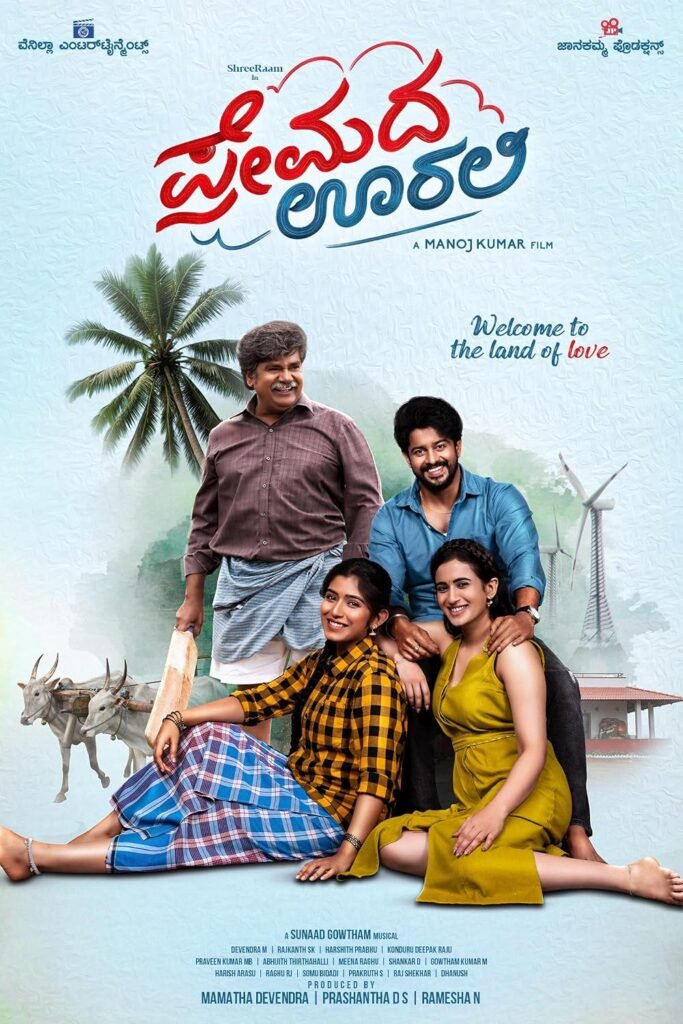
Manoj Kumar, who directed the National Award-winning film Akshi, has written and directed Premada Oorali, set in rural Karnataka. Naganna (Rangayana Raghu), a farmer, raises his son Santu (Shree Raam) alone after his wife’s death. He wants his son to marry an educated woman. Santu, however, has little interest in a city job or the promise of a more prosperous urban life. He wants to stay in his village and pursue farming. Two women enter his life: Rukmini (Thapaswini Poonacha), an educated woman from the city, and Vasantha (Ramika Shivu), his childhood friend who is in love with him. The story moves through marriage, misunderstandings, trust between individuals and the way society judges a woman’s past.
At its emotional centre is the relationship between a father and his son. The father wants his son to move to the city and make something of himself; the son is determined not to leave his village. This conflict is hardly new. Yet there is little doubt that the film has managed to establish an emotional connection with its audience.
That does not mean the film is without limitations. Like many mainstream commercial films, it does little to examine the economic uncertainties of farming, indebtedness, water shortages or the constraints faced by women in rural communities. Its treatment of a woman’s life before marriage, as well as the writing of some of its characters, also has its limitations. Commercial success, therefore, should not be mistaken for artistic or social perfection. Yet, even with these shortcomings, the film has found a place in the hearts of its audiences.
How did the film reach its audience?
An important part of Premada Oorali‘s success lies in the way it was publicised. With limited resources at its disposal, the team chose to reach audiences directly at the local level rather than invest in expensive advertising campaigns. It printed invitation cards designed to resemble wedding invitations and distributed them on buses and trains, around temples, at bus stands and in other public spaces. In Bengaluru, stickers and posters were put up on autorickshaws. In some places, the team also turned to older forms of publicity reminiscent of the way theatre productions were once promoted, with handbills and banners at street corners.
These efforts were reinforced by word-of-mouth publicity. Those who watched the film recommended it to others. Demand grew, theatres added shows, and single-screen cinemas in small towns and taluka centres began displaying ‘House Full’ boards—a sight that had become increasingly rare in many places.
At a time when films spend heavily on social media campaigns, digital advertising and pre- and post-release publicity, Premada Oorali demonstrates how traditional promotional methods, combined with audience support, can translate into commercial success.
Why does this success matter?
Budget is central to the economics of filmmaking. The higher the production cost, the larger the audience a film generally needs to recover its investment. Big-budget films are expected to generate substantial collections from the opening day itself. A low-budget film, on the other hand, may have a chance of recovering its investment with comparatively modest collections. But a small budget does not automatically guarantee success. A strong screenplay, disciplined production, appropriate casting, effective publicity and distribution are equally important for films of every scale.
The worldwide gross of Premada Oorali is several times its reported production cost. But gross box-office collections are not the same as a producer’s profit. Taxes and the shares retained by distributors and theatres have to be accounted for before one can establish how much money actually reaches the producer. Even so, the film has demonstrated that a production with limited investment can find a substantial audience.
Such successes matter to the film industry as well. In an economy that often revolves around established stars, opportunities for new directors, writers and actors can be difficult to secure. Many producers continue to invest in familiar faces and stories built around tried-and-tested formulas. When audiences embrace a small-budget film on this scale, it can encourage producers to take a chance on unfamiliar stories and new talent.
After Akshi, Manoj Kumar was largely seen as a director associated with art-house cinema. The extraordinary success of Premada Oorali has also demonstrated his ability to make a commercially successful film.
This shift matters to audiences too. The assumption that only big-budget films are worth watching, or that a visit to the cinema must revolve around a major star, deserves to be questioned. Different subjects, stories and ways of telling them need the opportunity to find an audience. When viewers respond to such films, producers, too, may find it financially viable to experiment.
This does not diminish the importance of large-scale productions such as the Kannada film Toxic, with its major star cast, lavish production and wide simultaneous release. But when a film such as Premada Oorali succeeds on the strength of a modest budget and a story rooted in local life, it offers the industry another model of success.
Rethinking what makes a film big…
Kannada cinema has, over the years, made room for a variety of stories through films such as Mungaru Male, Garuda Gamana Vrishabha Vahana, Lucia, Ondu Motteya Kathe, Kantara and Su From So. These films, from different periods and with very different approaches, demonstrate that audiences can embrace locally rooted stories alongside big-budget productions.
Ultimately, the success of Premada Oorali is about more than the box-office arithmetic of a single film. It is a reminder that there is more than one way to succeed in the film industry. A film’s stature cannot be measured by its production cost alone, nor can its opening-day collection be the final measure of its worth. What matters just as much is how long it remains part of public conversation, how many people recommend it to others and how deeply it occupies a place in their emotional lives.
A film becomes big not merely through the number of shows it commands or the money it makes on its opening day, but through how long it stays with audiences after they leave the theatre, and how far its story travels through them.
(The author is a screenwriter and film director.)